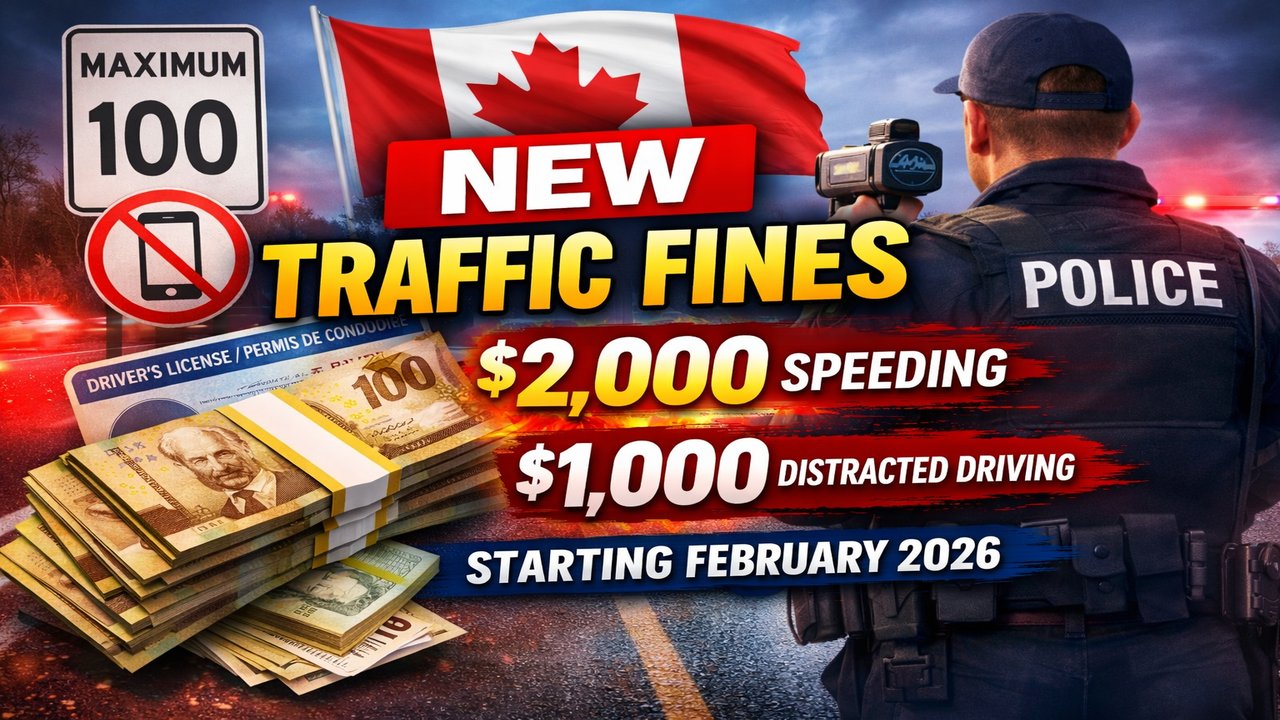
The federal and provincial governments have confirmed a coordinated overhaul of traffic enforcement rules taking effect in February 2026, introducing fines of up to $2,000 for excessive speeding and $1,000 or more for distracted driving.
The changes, announced in partnership with provincial and territorial authorities, are designed to standardize enforcement, reduce collisions, and strengthen penalties for repeat offenders. While traffic laws remain provincially administered, enforcement frameworks will be harmonized nationwide.
Officials say the new measures are preventive rather than punitive, targeting high-risk driving behaviours that contribute to fatalities and serious injuries. Drivers across Canada — including commercial operators — will be affected.

Why Canada Is Updating Its Driving Rules
Federal and provincial authorities cite several factors behind the February 2026 changes:
- Rising urban congestion in major cities
- Increased distracted driving incidents
- Persistent excessive speeding offences
- Safety concerns for pedestrians and cyclists
- Inconsistent enforcement standards between provinces
Transport and public safety officials have emphasized that stronger penalties aim to improve long-term driving behaviour and reduce insurance and healthcare costs tied to road collisions.
Higher Fines for High-Risk Offences
The most significant update is the increase in maximum penalties for dangerous driving behaviours.

Confirmed 2026 Penalty Framework
- Excessive speeding: Up to $2,000 (previously up to $500 in many jurisdictions)
- Distracted driving (e.g., texting): $1,000+
- Impaired driving: Higher fines plus licence suspension
- Repeat offences: Accelerated penalty escalation
Final fine amounts will still vary slightly by province, but maximum thresholds and enforcement practices will align more closely across Canada.
Standardized Enforcement Across Provinces
Previously, drivers could face significantly different penalties depending on where an offence occurred. Under the updated framework:
Read Also:
 $500 Canada Housing Support Confirmed for Eligible Tenants: Income Rules and Deposit Details
- Enforcement standards will be more uniform nationwide
- Demerit tracking systems will be better coordinated
- Repeat offenders moving between provinces will face consistent consequences
Authorities say this reduces confusion and strengthens accountability for interprovincial drivers.
Mandatory Safety Programs for Repeat Offenders
Drivers with multiple violations may be required to complete government-approved safety courses.
Programs will focus on:

- Defensive driving techniques
- Managing in-vehicle distractions
- Impaired driving awareness
- Risk assessment and hazard prevention
Completion may be mandatory before licence reinstatement in certain cases.
Impact on Everyday Drivers
Minor Infractions Will Carry Greater Consequences
Even lower-level violations — such as failing to signal or using a phone while stopped at a red light — may result in:
- Higher fines
- Faster accumulation of demerit points
- Increased risk of short-term licence suspensions
Drivers accustomed to less aggressive enforcement could see significantly higher costs beginning February 2026.

Commercial Drivers Face Stricter Oversight
Delivery drivers, transport operators, and ride-share providers will be subject to enhanced compliance expectations.
Employers may need to:
- Update internal safety policies
- Train drivers on new enforcement standards
- Monitor compliance to reduce liability risks
Commercial fleets account for a meaningful share of traffic incidents, prompting tighter monitoring.

Greater Protection for Vulnerable Road Users
The reforms emphasize pedestrian, cyclist, and motorcyclist safety through:
- Stricter distracted driving enforcement
- Harsher penalties for unsafe passing
- Reduced speed tolerance in high-foot-traffic zones
Authorities aim to reduce collisions involving non-motorized road users, which have risen in several urban centres.
Financial Impact on Households
The increase from a $500 speeding fine to as much as $2,000 represents a substantial financial shift. Beyond fines, drivers may also face:

- Higher insurance premiums
- Legal costs
- Licence suspensions
- Mandatory safety program fees
For households managing rising living costs, avoiding infractions will be financially critical.
How This Compares to Previous Enforcement Periods
Before 2026:
- Maximum speeding fines were typically lower
- Distracted driving penalties ranged between $300 and $500
- Interprovincial coordination was limited
Beginning February 2026:

- Maximum fine ceilings increase sharply
- Repeat offences escalate more rapidly
- Enforcement tracking becomes more consistent nationwide
Officials say the goal is deterrence, not revenue generation.
Why the Changes Were Introduced
The overhaul follows years of public safety consultations and rising concerns about distracted driving, particularly mobile phone use behind the wheel. Inflation has also reduced the deterrent impact of older fine structures. Adjusting penalty amounts reflects updated economic realities and aims to reinforce behavioural change.
Public safety analysts suggest stronger enforcement could lower long-term insurance claims and healthcare costs linked to collisions.

What Drivers Should Do Now
With implementation set for February 2026, drivers are advised to prepare early.
Review Provincial Updates
Each province will publish detailed enforcement guidelines before the launch date. Monitor official transportation ministry websites for updates.
Adjust Driving Habits
- Eliminate mobile phone use while driving
- Follow posted speed limits strictly
- Maintain safe following distances
- Be cautious in school and pedestrian zones
Educate Household and Fleet Drivers
Families and businesses should ensure all drivers understand the new framework to prevent unexpected penalties.

Consider Voluntary Safety Training
Taking a defensive driving course voluntarily may improve road awareness and reduce the likelihood of future violations.
Expert Outlook
Traffic safety specialists believe combining higher fines with education programs could significantly reduce repeat offences. Insurance analysts note that fewer collisions could eventually stabilize premium increases, though immediate reductions are not guaranteed.
Legal experts say harmonized enforcement strengthens accountability and simplifies compliance for interprovincial drivers.

Beginning in February 2026, Canada will implement stricter, more standardized traffic enforcement rules, including fines of up to $2,000 for excessive speeding and $1,000 or more for distracted driving. The reforms focus on deterrence, repeat offender accountability, and enhanced protection for vulnerable road users. Drivers nationwide should review updated provincial guidelines and adjust driving habits ahead of enforcement.
Frequently Asked Questions (FAQ)
When do the new driving fines take effect?
The updated enforcement framework begins in February 2026 across provinces and territories.
How much is the new speeding fine in Canada?
Excessive speeding could carry penalties of up to $2,000, depending on the province.
Read Also:
 Service Canada Payment Cuts Confirmed: Seniors, Families and Disability Recipients Impacted
What is the distracted driving fine in 2026?
Distracted driving offences may result in fines of $1,000 or more, plus demerit points.
Is this officially confirmed?
Yes. Federal and provincial authorities have confirmed the coordinated enforcement update for February 2026.
Do I need to apply or register for anything?
No. The changes apply automatically to all licensed drivers.
Read Also:
 One-Time $236 Federal Grocery Support Confirmed: Payment Timing, Income Limits and Key Details
Will this affect my insurance?
Multiple violations could lead to higher premiums or policy consequences.
Will this impact CPP or other government benefits?
No. Traffic fines do not affect CPP, OAS, EI, or CRA benefit payments.